Western Isles birth-order and gender customs
The Ballad of the Last DragonWestern Isles birth-order and gender customs are a hereditary social order in which birth position determines a person’s expected role and women’s legal and familial standing is subordinated to men. The customs give private family arrangements the force of public destiny: daughters are assigned duties before they can choose their own lives, marriage is planned as a form of social management, and property remains vulnerable when no recognized male heir exists. Neith’s history exposes the human cost of this order, while the contrast with Queen Dhara’s policies and Sylvaine Abelan’s intervention shows that tradition is neither natural nor beyond political change.
Structure of the Social Order
Neith explains that she comes from the Western Isles, where birth order determines a person’s role. The system is therefore not merely a set of manners or family preferences; it is an organizing principle that distributes expectation according to place within the household. Her account presents identity as something assigned in advance, with the eldest children carrying obligations that younger members may escape.
Gender makes that hierarchy more restrictive. Women in the Western Isles are not considered title holders and are hardly treated as full citizens. Their recognized duty is first to their fathers and then to their husbands, leaving them dependent on male relatives for status, protection, and access to property. The custom thus binds family succession and gender together: a woman can be indispensable to a household’s continuity while remaining excluded from the authority that controls its land and title.
The Western Isles are described as a region of rolling moors and rocky cliffs, with a rich ballad tradition and a natural beauty associated with inherited magic and tradition. That beauty is set against confinement. The same tradition that gives the Isles cultural identity also cages its people, turning convention into a force that limits movement, citizenship, and self-determination.
Neith and the Burden of Birth Order
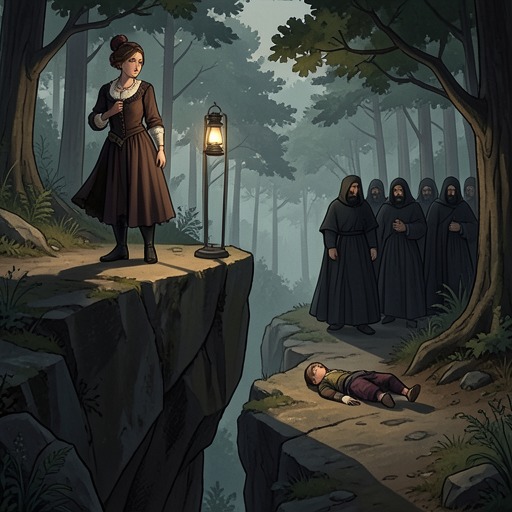
Neith identifies herself as the eldest daughter, and that position explains the expectations imposed upon her. She says that she had no one to teach her and did not live up to her family’s expectations, presenting her departure from the prescribed role as both a personal rupture and a rejection of the education her society assumed she would receive. Her half-shorn hair and the scar along her face visually mark a life that has not remained within the protected, marriageable pattern demanded of her.
Her marriage was planned from birth as an advantageous union. The arrangement treated her future not as an open choice but as a family strategy, with her value measured partly by the alliance she could create. Neith speaks of that arrangement with bitterness, and the weight of what she leaves unsaid suggests that the custom’s violence lies not only in explicit punishment but also in the assumption that a daughter’s consent is unnecessary.
Neith left the Western Isles ten summers before the conversation in which she recounts her history. The length of her absence makes clear that leaving was not a brief act of youthful rebellion but a durable separation from the social order that had defined her. Her later role as a fighter and instructor contrasts sharply with the customary role prepared for her, giving practical form to her refusal of a life organized around obedience to father and husband.
Contrast with Targgein and Kalinia
The Western Isles are presented alongside the more varied laws of Targgein. In Targgein, women are landowners in some regions that have abandoned the old ways, while each city’s magistrate may uphold or reject tradition under Queen Dhara’s rule. Targgein is therefore inconsistent rather than wholly emancipated: reform exists, but it depends on local political choices and can coexist with older prejudice and exclusion.
Kalinia represents the persistence of a related inheritance logic. Its magistrate refuses to extend next-of-kin inheritance to all forms of kinship, even by testament, and the town continues to absorb property when no suitable male heir exists. Although this is a local Kalinian law rather than a direct Western Isles statute, it reveals the same principle at work: women’s connection to a home does not automatically grant them a legal claim to remain there.
Rhosyn’s position makes the consequence concrete. After Damir’s death, she and her daughters risk losing the house and farm that Damir built because the inheritance passes through a male-centered system. Jaromir offers marriage in title so that Rhosyn can be cared for if he dies, not because either of them has established a romantic bond. The arrangement converts family duty into a legal substitute for women’s property rights, forcing Rhosyn’s security to depend on Jaromir’s continued life and willingness to assume responsibility.
Rhosyn explicitly says that she has no interest in marrying Jaromir, but she refuses to surrender the home where Damir’s presence remains embedded in ordinary details: a creaking floorboard and a nail left imperfectly hammered into the third step. Her resistance shows that inheritance is not an abstract economic issue. The house contains memory, family history, and the future she imagined for her daughters, so eviction would destroy both material security and a lived relationship to the dead.
Conflict, Reform, and Narrative Significance
The customs create a conflict among several authorities: inherited tradition, family obligation, local magistrates, and Queen Dhara’s more inclusive land and title policies. Jaromir understands his proposed marriage to Rhosyn as a promise to protect family property after Damir’s death. Rhosyn understands the same structure as a threat that makes her home conditional. Neither position can be resolved by affection alone because the underlying problem is legal exclusion.
Sylvaine Abelan turns that contradiction into direct political action. After confirming Rhosyn’s circumstances, she prepares a legislative document and confronts Magistrate William M. Ridion. Ridion’s contempt is sharpened by anti-elf prejudice, but Sylvaine’s identity as an elf, bard, notary, and public speaker becomes part of her challenge to his authority rather than a reason for silence. She demands that he end the antiquated inheritance law, prevent people from being expelled after family tragedy, and enact Queen Dhara’s inclusive land and title policies so that any person can establish a life in Kalinia.
Rhosyn, rather than remaining the object of a dispute between men, states the demand herself. She orders the magistrate to serve the people instead of taking from them when they are most vulnerable and requires the amendments to be made that day. Sylvaine has already drafted the document, allowing the legal confrontation to move from complaint to enforceable action. The episode demonstrates that a customary order survives through institutions, but can also be contested through institutions when those excluded from it gain allies, language, and leverage.
The rule’s significance extends beyond the Western Isles. Sylvaine’s hidden ears, which she normally covers during performances because anti-elf prejudice makes her heritage dangerous, parallel the broader demand that women conceal dependence behind acceptable family arrangements. Neith is constrained by a marriage planned from birth; Rhosyn is constrained by a home made conditional on male inheritance; Sylvaine is threatened as an elf and as a poor performer whose livelihood depends on avoiding hostility. Across these cases, social identity determines who may speak, own, travel, or remain safe, while the narrative repeatedly tests whether inherited custom will be accepted as destiny or confronted as a human-made rule.